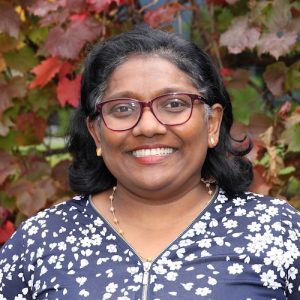
Erosha explains how her family created a microenterprise for their daughter, Sethmi, based on subtle interests they noticed during the Discovery process.
Erosha’s daughter Sethmi, who is in year 9, is the focus of Erosha’s presentation.
Erosha will share how her family created a micro-enterprise for Sethmi based on subtle interests they noticed during the Discovery process. She’ll explain
- how their family has approached Discovery to learn about Sethmi’s interests, needs and skills
- how they created work experience activities for Sethmi
- how they recognised and tested Sethmi’s interest in food preparation at school and home
- how they thought about a product that Sethmi could make
- how they came up with the idea to approach a food-based business for an opportunity for Sethmi to sell her product
- what this opportunity has taught Sethmi’s family about Sethmi
- what they will be exploring in the future.
Transcript
Erosha
Yumalandi, welcome, and ayubowan: That’s Sri Lankan, that’s Sinhalese, rather, in welcoming you.
This is my lovely daughter, Sethmi. She will talk a little bit about herself now. Over to you, Sethmi.
Sethmi
Hi. I am Sethmi. I am a big sister. I love cooking. I go to St Clare’s College. I have a business. My business is Serendib Treats. I make rice bliss balls. Maybe you would like to try one? My mum Erosha will talk more about me and my business.
Erosha
So, thank you, Sethmi. Hello again. My name’s Erosha. I’m Sethmi’s mum and I have three beautiful children, including Sethmi, who’s the eldest and a wonderful, supportive husband, Suranga. And Sethmi keeps me true to a lot of things in life, and I really appreciate that feature of her. So I’d like to acknowledge she’s come a long way and done a lot to come to where she is, and yeah, she deserves all the credit for that.
So this is Sethmi’s vision that we sort of built some time ago, when I happened to come to an Imagine More vision building exercise or a workshop that happened about eight years ago, I think so, yeah. So, our vision for Sethmi is that she be a valued member of the community, having a meaningful life and contributing to her community and accessing all the good things in life has to offer.
After her successful transition to high school in 2021, we knew it was time to look at some employment opportunities or what employment will look like for her. That’s why our first sort of bigger goal in her vision is to have… enhance a business and explore meaningful, rewarding work opportunities.
But I’ll sort of rewind back a few years when I go through the journey here.
We knew it was time to look at her future employment opportunities, and having this vision has really helped us be grounded in that journey, especially to look at inclusive opportunities and especially in terms of her employment and her future life after school. So you may have noticed that we have that as a top priority in our goals for her. So, this is why we went intentionally to explore Discovery.
So how did Discovery help us? So, by now, I’m sure you know… that you’re quite familiar with the word Discovery or the term Discovery. I think Milton painted a really good picture as well, and you’ve heard a lot about how people have gone through that process.
So we didn’t really know about Discovery until a few years ago, so we spent a lot of time understanding what Discovery is and participating in a lot of capacity-building workshops. And this might be news to you, but those workshops were all Imagine More ones. So, yeah.
And we are also part of this fantastic peer group that Imagine More runs, which is called the Customised Employment Peer Group. And we’ve got so many, like great ideas and opportunities to talk with parents who are like us and some parents who are further along the journey. So it’s helped really massively to be a part of that group, to really understand. And, on a personal note, it was really fantastic for my husband, Suranga, Sethmi’s dad, to be involved in it as well because most of the time I attended all the conferences. I sort of go to all these capacity-building programs, but he gets stuck with the mundane, you know, making money for us kind of thing. So yeah, it was really nice that he was able to be part of that group as well, so that he can get a firsthand experience of the things that I’ve learned so far.
And so, Discovery to us meant that we needed to really understand what motivated and helped Sethmi to be engaged in a task or activity and then to see how it can translate into a work opportunity. So we had our eyes and ears open. We took notice of what things Sethmi would really be engaged in without hesitation, and tasks that just took a little bit of convincing and nudging. So, it helped us to sort of differentiate what really intrinsically motivated her.
To give you a bit of context: With her disability, Sethmi does find communication hard. She finds social engagement a little bit challenging, but given the right kind of supports and environments, she flourishes in those circumstances as well. So, another thing I guess I wanted to sort of tell you about Sethmi is she has this lifelong passion of seeking regulation through a sensory tool or an item. So, if you’ve met Sethmi in person, you will notice that she always carries something in her hand, which is actually a piece of plastic. If you see the photo on the right, she’s carrying one in that as well, a little… I put an arrow there, I hope you can see it.
But yeah, it’s kind of her anchor in life. She uses it to regulate herself by rubbing her fingers in a circular movement. And it provides her with the necessary sensory input to ground herself. So we knew this was an important part of her life, and we wanted to see how this fascination can translate into a work role. So, yeah, it might be surprising for you to know what opportunities and things we envisaged in the end, but we had to look beyond that sensory kind of aspect of it. So, if I go into a little bit deeper, for example, we paid more attention to the circular movements that she used to do with the use of the sensory item.
So, for example, she would rub her hands around and round. And we also noticed that she… when she’s doing any painting or drawing, she uses the same kind of movements. It’s something that is intrinsic in her. So, you know, that was something that we thought we need to pay a little bit more attention to.
And, you know, you’d learn along with the presentation, you’ll see how it actually made a bigger, like a really good fit in terms of us coming up with her microbusiness. This is what Discovery lets you do so, for us, Discovery helps us to learn how to focus on little parts or particular parts of tasks that Sethmi seems to excel and enjoy in.
So when it came to things like which part of the activity did Sethmi like most, so we paid attention to these things. So which parts of a task did she struggle with? Did she initiate a task or did she complete particular tasks? Did you know that she completed this task? And did she need encouragement to keep going in the task, or whether she needed breaks?
What motivated her, and how long will she be actually be engaged in the task? You know, is it five minutes, 10 minutes? You know, kind of have a little bit of an idea how long her, how long she’ll be focused on. So I can tell you we have found some fascinating and valuable information that really helped us support Sethmi better. So, especially when you look at it from an employment point of view.
What did we observe? So through this Discovery process, we realised that Sethmi liked many things associated with food preparation, including tasks such as packing, unpacking groceries, unpacking the dishwasher, stirring and mixing in terms of during dinner preparations.
And she seemed to work seamlessly when the activity involved a very clear step-by-step visual process. For example, let’s say she’s putting the groceries away, we found that she can stay on the task, knowing where… she knew where everything went. And she completed it with almost no breaks.
And she really seemed to enjoy putting things away. And on the other hand, if she was like, say if I was asking her help to wipe down a table after dinner, this process was a little bit tricky for her. She would, you know, whatever she sees, like crumbs, she will wipe it off. But it’s not a real proper job. So like, you know, she won’t do a proper cleanup because, you know, for her it looks clean.
So going through Discovery really helped us to be more mindful of some of the aspects that she enjoys. And see what’s beyond the surface of that activity. For example, during COVID times, she had to do a Food Tech assignment to make rum balls. So she had to follow a recipe and then send a photo as the end result, like end thing for the assignment. And we could see she really enjoyed that assignment compared to, you know, some of the other stuff.
And we helped her to find a visual recipe because we knew that was her strong sort of foundation, visual help. And she needed a little bit of help in the measuring, but having a clear step-by-step process was helping her to be on track and, you know, be independent. Additionally, we realised that since she was, you know, since this rum ball exercise didn’t have cooking on the stove involved, there was less supervision needed, and she was able to sort of complete it independently.
And because there’s no stove involved, that meant she can actually take breaks when she wanted, so she can stop what she was doing, go away, have a little moment, come back and complete the task because nothing’s going to go on fire. So in fact, this is probably what actually led us to explore her micro business, which is actually of making bliss balls Sri Lankan style. So, yeah, so this is probably why I sort of ended up having that light bulb moment thinking, “Oh, she could make this amazing bliss balls we make in Sri Lanka, and you know, that could be like a great thing for her to try”.
So yeah, we also observed that everyone around Sethmi had different perceptions about what she was good at. So, we also sought other people’s information through this Discovery process, and we involved them by simply asking questions. You know, I used to hound the teachers. I’d pick up and drop off and just, you know, slide a question here and there and ask them, “What did you think she was, you know, good at with these things?” So it gave us an immense amount of different information because she’s a different person in different settings sometimes.
So, we would know her one way, but when in the presence of peers, she seems to really, you know, step up and keep up with her peers because, you know, you don’t want to be second to appear now, do you, you want to get on and be on that bandwagon. So, yeah.
So we also observed that Sethmi did positively when she had some experiences in an activity, like for example, when she was going to go on a three-day camp from school we knew that that would be maybe something that would be challenging for her. So what we did was we actually went to the venue, which was in Sydney. We actually went there and spent some time so she got to know the venue. So when it actually came to camp time, there were little unknowns to her. So the venue was known. We could show her with the photos so she’d know where she’s going. So some of those anxieties that come from the unknown actually is taken away. And those are things that are in our control. Obviously, we can’t control what happens during the camp time, but those were things we could do. And that was another thing that we discovered was something that was going to make her successful in anything she does.
And also, we asked her primary school teachers what she was, you know, what things interested her, what things really got her going. And she was really good at getting up at the morning assemblies and doing some of the parts of hosting the assembly. She loved having a mic. You know, she wouldn’t really talk too much to you, but give her a mic and a script and off she goes.
Yeah, so she happily engaged in the home duties involving food preparation. As I mentioned, she was a strong visual learner, so having a visual schedule helps her. And she loves her routines, so that’s why she’s not here today. She loves going to school. She loves keeping her school day, so she’s having a great time learning whatever she’s learning there. So yeah, so that’s important to her.
And structure is important to her. And when she has a visual schedule, she also knows what the end result is, the end product is. So, if the end product is visual, that also helps her. And better engagement with some of the learning in units, like we found out how she was really good in the food tech assignments, so that clearly was very motivating for her. Food was intrinsically motivating to her, so, yeah.
And it also helped that we involved a lot of people around her and not just talk to us, the, you know, the little inner circle, but we went further on and sought a lot of people’s input in this process.
So what we learned in terms of interest, that she has a strong interest in food preparation, typically short ones, and she loves packing and unpacking.
And in terms of conditions for success, she’s a great visual learner. She loves the step-by-step routine, focused, clear structure. And she loves a bit of pre-warning, but with that, there’s a bit of a caveat. She doesn’t like, I mean, she gets a bit anxious if we give her too much warning. So we need to have a balance there. So if she was doing something, for example, at school that was different to her timetable, let’s say Wednesday there’s an athletic carnival on, the warning should happen that week Monday, not the weekend before, where she’d be thinking about it too much. So knowing that was important.
Look, this is some of the contributions that Sethmi has shown so far. She’s become this beautiful young woman, surprising us every day with her courage and perseverance. And you know, there are some contributions that we’ve certainly learned through the Discovery process. And it helped us to list it down. And I love the fact that… I think Milton mentioned that Discovery journal that Jan and Fiona was talking about. You know, I have a little jar on my kitchen table. Anytime Sethmi does something that surprises me, I write it down and just, you know, might be an invoice from, or a bill, but on the other side I’ll write it down and pop it in the jar so that I won’t forget. Because we all live busy lives and we tend to forget some things that, you know, sparks us.
So whatever that sparked that little interest or, you know, whatever. I thought, ‘Oh, that’s really interesting, Sethmi did this today’, really quickly write it down and put it in the jar. So it’s kind of like that Discovery journal, but in a different format.
So, the contributions, really prompted us the fact that she can, she’s really good at mixing, rubbing, and keeping things in order, packing and unpacking and timekeeper part, I have to explain that. At night, around 8:30-9:00, Sethmi comes out of her room and she’s like telling us it’s time to go bed, like in her own way, and she’ll, you know, get everything sorted, clear the dining room table, put the chairs up, put our little… we have a robo vacuum or whatever that does the vacuuming for us, (best investment) and she’d do all that and then, you know, switch off the lights and put, like put, we call it Robbie, put Robbie on and, you know, switch off the lights and let everyone know that we need to go to bed. Such a good timekeeper in that sense. She’s got an amazing body clock. So we are really… we really depend on her for that because we sometimes get distracted with our everyday, you know, stuff going on. But she is such a good timekeeper in that sense. So she’s got that really great role in her. So that’s one of her contributions at home, I should say.
And, she is a task completer. And she’s also someone who puts things away where they belong. So she is fantastic. If she gets the scissors out, they actually go where they belong. I don’t have to keep looking for them, unlike my other family members. So, you know, I had to tell them ten times to put the scissors away or whatever they’ve taken away. But with Sethmi, if you take something out, it goes where it belongs. So it’s one of her great contributions to our family, and I’m sure to an employer one day.
So, with these contributions in mind, we actually… and that exercise of doing that rum ball assignment at school during COVID time, we knew that Sethmi had a passion for food and food preparation, and she was so engaged. So we came up with this idea of a micro business where she would be making Sri Lankan-style rum balls. So actually, there is this rice-coconut bliss balls that we make back in Sri Lanka. It’s actually you know, when you eat rice every day and you have leftover rice, Sri Lankans would dry it, really great hot weather to dry it as well, so dry it, pound it, and make rice flour from that leftover rice and add a bit of coconut, freshly scraped coconut and treacle and voila, you come with, well, I shouldn’t have said voila, that’s French, not Sri Lankan. But yeah, you come up with bliss balls, Sri Lankan style.
So, it’s so simple, and you know, usually eat it as an afternoon snack. So I thought, oh, that makes sense. It’s a process that doesn’t involve cooking on a stove, because that would mean more supervision, more time, and it would also mean Sethmi could have her breaks whenever she wanted. If she wanted to have a break, she could leave whatever she was doing and come back to it because it’s not a process that’s affected by time, per se.
So, it sort of tied in really well. It was not risky to do it. It… financially, it was not going to put a hole in our mortgage or, you know, you whatever finances. It was such a great investment, but we were able to do that investment because it wasn’t this huge, humongous thing.
So guess what? It has a really seamless step-by-step process. So that really helped. We knew through Discovery that really helps Sethmi, so… and the end product was visual, tick, tick, tick. It was easy to try, and most of all, it was under our control. No one’s going tell us what we make in our kitchen, so we could go ahead and try it.
Also, to give you some perspective, Sethmi was born in Sri Lanka, and she loves her rice and curry and her Sri Lankan food. So it kind of was something she would be really intrinsically motivated to do, I think. So we went ahead and tried it. That gave birth to Serendib Treats. If you don’t know, maybe, you know, Serendib was one of the names that Sri Lanka was called, long, long, long time ago, so that’s why it’s called Serendib Treats. And because we sell sweets, mostly, it’s called Treats. So Sethmi sells rice-coconut bliss balls, which are actually a combination of roasted rice flour… I’m giving away my recipe, aren’t I? Well, anyway, it’s okay. Rice flour, then coconut; we use desiccated coconut, and treacle. The best treacle is from a tree called Kithul, so it has to come from Sri Lanka, but it’s readily available here, so no big deal. So those are the main ingredients that go in it.
And then we looked at making those as something she could sell somewhere. Once we sort of looked at whether she was happy to make something like that, then we went about getting some more information, and I remember to this day having a wonderful conversation with our employment guru at Imagine More, Fiona, having a wonderful conversation about how we can further this along like this, her interest in food and, you know, we’ve come up with this kind of easy recipe that she can do: How can we go about making this a business? Yeah.
So we ended up looking at how to make these bliss balls and make it a visual… we made a visual recipe out of it, and Sethmi was wonderful following it, and she’s become so independent making it, we only need to support her in only few aspects of her… the recipe following.
And she, you know, you ask her, “Do you want to make some rice-coconut bliss balls?” And you know, a minute, half a second later, she’s there all ready, guns blazing, wanting to do it. So we haven’t seen that kind of engagement with her in anything. So it’s been really, really encouraging to see that.
So this is her website. She also sort of, that’s sort of like a gateway where you can find out more about it. The website information is www.serendibtreats.com.au. A little bit of marketing there.
So the key takeaways, I guess is, you know, you’ve got to keep observing and listening, and you’ve got to do that with your family member. And be patient and give it time, like Helen mentioned, don’t rush through it. There’s a process. Follow it, do Discovery, and just, you know, just go with it for a bit. Spend some time, go with it for, you know, six months or whatever it takes. Don’t rush. Don’t jump into the job like Jan mentioned on the first day.
And then be creative. You know, you might not have funding, you might not have the best support person. You might have so many barriers. Put them aside and look at things that you can do; what you have under your control and try to go with those. And also be brave. You can ask for help. There’s lots of help out there, especially people around you, your family members, your friends, they all want to help. Sometimes they just don’t know how, but if you spell it out to them, ‘this is exactly what I want from you, ’ they will do it for you. There is an art of asking, but you’ve got to make that first step.
And continuing to look for growth and opportunities. I think that’s very important.
And also always being true to your family wishes, so I mean Sethmi’s vision. We always look back at Sethmi vision and go, ‘Oh, that doesn’t really fit in with what we envisage for Sethmi. So, you know, scrap that.’ Go ahead. You can do that. It’s okay. You can get it wrong. That’s okay. Go back to the drawing board and look at what’s important for your son or daughter, and just, yeah, keep true to that vision.
And I also might add that SRV… knowing Social Role Valorisation has really helped me make those decisions in a well-grounded way. So if you haven’t learned about SRV, I think invest your time and energy to getting to know about it because it really gives you that… enough strategy, enough resources, rather, to really think clearly.
One last thing: Don’t rush Discovery, like Helen said, let it take its course. Thank you.
Meet Erosha Bakmiwewa

Erosha came across Imagine More at a crucial time in her oldest daughter’s life and, as a result, successfully advocated for Sethmi’s inclusion in mainstream education. She has since used the principles of Social Role Valorisation to carve a pathway for getting the good things in life for Sethmi and her other children.
When she’s not supporting other families to reclaim their dreams for their family members with disability, Erosha is likely to be found cooking for others, entertaining family and friends, engrossed in a good conversation, or working her way through her collection of books.
Meet Sethmi Lekamarachchi

Sethmi started her journey towards an inclusive education when she was in Year 2, and since then has been a force to be reckoned with. She has been pleasantly surprising her family, teachers and friends with her achievements so far.
As a micro business owner, Sethmi has been making gains in finding what motivates her to run a food business. She has proven that nothing is impossible for young people with disability when the right kind of attitude and supports are available!