How Customised Employment enabled Ryan to surpass everyone’s expectations

Corinna Gilligan explains how creative thinking and exploration of Customised Employment enabled her son Ryan to surpass everyone's expectations

Corinna will share how she, her family, and Ryan’s support team have explored Customised Employment for Ryan to set up a couple of micro-enterprises. You will hear:

  • how Ryan’s family have approached the Discovery process and what they have learned about his strengths, interests, and contributions during and after school
  • how the Discovery process continues to evolve
  • having encountered low expectations at Ryan’s school about his abilities, what they did to create opportunities for Ryan’s work experience in years 10 – 12
  • how they set up microenterprises focused on recycling and woodwork to provide opportunities to learn more about Ryan’s interests.


Transcript

I am the very lucky mother of three amazing young men, and I have the most gratifying role in the world of being their mother. And today I’d like to share a little bit about my youngest son, Ryan, and his journey of employment over the last five years since we moved to Canberra. And I’d like to say that Ryan elected not to come here today because he wanted to go to work, but that he has looked at all of the material and has given me permission to use it today to talk to you guys.

What I’d like to talk about today is firstly about how important it is to have high expectations about your young person with a disability, especially when a lot of people around you don’t necessarily have them. And then we’ll talk a little bit about the exploration and experimentation process that we went through, centred around employment. And then we will look at what we learned from those experiences and why we then decided to set up, as Jan said, a multi-faceted microenterprise or two microenterprises, both under one umbrella.

So, having high expectations. It’s really important that we believe in our children, and I would like to introduce Ryan. He’s 21 years old. He is known at home as the Pizza Terminator because he just eats pizza for dinner every night. He’s a gym rat. He loves going to the gym and goes two or three times a week. He’s a woodworker without an r. A retro gamer. He loves gaming just like most young men, but he likes using an N64.

He’s a huge supporter of the Canberra Gunners basketball team. He is a dissectologist, which is a fancy word for someone who loves doing really horribly complicated 1000-plus-piece puzzles. He’s a handyman around our house. I don’t have to change light bulbs anymore. He does it for me. And he also tells me if I have or haven’t got the right bulbs in store, because I always want to go and buy them, because I can’t remember where I’ve put them. And he’s also the founding member of his two microenterprises.

In a deficit-biased disability world, which we inhabit for quite a substantial part of our lives, Ryan was seen as a young man with level three autism, an intellectual disability, a language deficit, severe auditory processing issues, and also acute sensory issues.

He was a graduate of a special school. He was signed up with a DES provider while he did a Cert II in Hospitality ASBA (Australian School Based Apprenticeship) at school, and that DES provider that he was with for 22 months was unable to get him even an interview, let alone a job of any sort. So he was deemed unemployable by them, and just before he graduated from school, the recommendation that we were given by his school was that he was a prime candidate for segregated day programs.

Now, as a family, we knew that Ryan was capable of so much more than that and that he wanted purpose in his life. And luckily, thanks to workshops that we’d attended, given by Imagine More and various other amazing people, we had already crafted a vision statement for Ryan and we knew that Ryan, if he were able to speak for himself, through his actions had already told us throughout his life that he wanted to have the same opportunities and life expectations as his brothers. He wanted to be like them. So when we crafted our vision around that statement, we basically came up with, if he were to voice his vision, he would say, “My vision is to lead a balanced and fulfilling life in which I’m an included, contributing, and valued member of my local Canberra community.”

And I have to tell you, it is Canberra. We moved here at the end of 2017, and Ryan, since we have arrived, has told me he’s from Canberra, he’s a Canberran, and he’s never leaving and he never wants to get on a plane again in the rest of his life.

So, when we crafted his vision statement, we put together a lot of other statements about what that meant for him. And so when we started thinking about employment and the fact that Ryan wanted to be like his brothers and have a job, we had a look at what we’d written down within those statements that might pertain to employment. And basically, Ryan had specified, or we had crafted together with Ryan, that he would have meaningful, paid, full-time employment in a sector that was of his interest.

So he wanted to work like his brothers every day, that he wanted to be financially secure. He wanted to be recognised as a lifelong learner, and that, within his work, he would need new experiences and skills, and an opportunity for growth, and that he would be appreciated for what he did and that it… he would be valued as seen… and seen as an asset by his employer.

We also knew that Ryan had experienced all sorts of different schooling opportunities. He’d gone to a standard school and been in a normal class. He’d been in a special class; he’d been homeschooled. He went to, during our travels, went to an amazing school where neurotypical kids or siblings and neurodivergent children went to school together, so it was a really inclusive school. So he’d gone through that process. And he’d gone to a special school. And having experienced that, especially having experienced being in a special needs school, he knew he didn’t want to be segregated in a disability group with people that he had nothing in common with other than he had a disability, and their disabilities were so different in any case.

He didn’t want to work in a segregated disability environment doing things that held no interest to him. And he didn’t want to do valueless work, and he didn’t want to be seen as a burden. His employment goal was, again, just to reiterate, that he would find meaningful employment that inspired him, he’d have a full-time job, he’d be paid, it would be socially inclusive, and that he would be able to make friends in his own way, which is not the standard way that you and I might make a friend, but for him being with somebody, being next to them, they’re his friends, if they’re gonna spend time with him.

And he wanted to be valued and acknowledged for his contributions and accomplishments, and he wanted a job that would have room for growth, so that he could grow into the job and then the job could grow with him.

So, come year 10, we decided that it was time to start looking at employment opportunities for Ryan and to start experimenting. Now, Ryan hated school at that stage, so we made the decision that rather than keeping him in school, that we would actively look at getting him as much employment work experience anywhere, because we figured we could learn something wherever he went, and he would actually be much happier than being at school.

We had recently arrived in Canberra, so we didn’t know very many people, so we started asking around anybody that we met if they knew about any work-based opportunities. And basically, we started in year 10, and then in year 11 and 12, before COVID hit, we actually achieved that Ryan was working four days a week and going to school one day a week.

And during COVID, we were able to continue experimenting with some of the work experience that he’d been doing before. And we also did some volunteering, and we then observed and documented all his actions, skills, abilities, and the compensations that he might need within a work environment.

So the first thing that we did was talk to absolutely anybody and everybody that we could about looking for work experiences for Ryan. The first people we spoke to were at school, and within school he was given the option to do the modified Cert II in Hospitality, and as part of that, he got to work in the school cafe.

And then Ryan wasn’t a prime candidate at school for work experience because he was nonverbal. But through pestering and asking all the time, we were actually given an opportunity for him to go and work at Bunnings one day a week. The school was unable to provide us with a support worker. At the time, we didn’t have the funding in our NDIS package, so I went along as his support worker. We asked around friends that we’d made at school, and one parent worked in a school canteen in Calwell, right the other side of Canberra, but they were willing to give Ryan an opportunity to work within the canteen one day a week, so we did that.

We basically spoke about Ryan to anybody we met, and through that, we met a man who was willing to take Ryan to a tech shed where they dismantled computers for their parts. And so he got that opportunity. And then, through getting to know that man, we discovered that he was actually a qualified woodworker, and with time, he had an opening for taking Ryan to our local Tech Shed and do some woodwork. So, it was pretty cool with one man, we got a double hit, a double whammy of opportunities.

We spoke to all of Ryan’s life skills support workers, and it transpired that one of them had worked in hospitality before. And so we asked him if he was willing to contact any of the places that he’d worked in previously and whether they would give Ryan an opportunity. And so we got him an opportunity to work a lunchtime shift in a very small niche restaurant in Canberra.

I did volunteering at Meals on Wheels, so Ryan got a gig doing that with me as my companion. And then, we also used experiences or work opportunities at home for Ryan to learn as much as we could about him there as well.

So we created the opportunities for him to work. We got him out there, and then we started observing what we could learn about him as he was doing these things. So when he worked in the cafe, we learned that he could follow some reasonably complex procedures, especially if they were broken down for him, and we created sort of like visual social stories about what he had to do and how he had to do it.

He could overcome his sensory issues and the anxiety associated around those issues with modifications. But once he realised that he could do something, then those modifications could be withdrawn. And we also noted that he just really didn’t like talking to the customers. It was just too hard for him to try to process the language, and to have a back-and-forth conversation with them, was just out of his realm of capability. But he could do all of the stuff that was not involved with clients.

At Bunnings, we learned that he loved wearing a uniform and being part of the team, and the fact that he was wearing that uniform made him feel like he really belonged there. But he really liked to work in parallel with people, not having people hanging around him telling him what to do or observing him, but actually working with him. But he didn’t like working on his own. He liked to have the company and the security of somebody close to him.

And that he really struggled with verbal instructions. It didn’t matter how short they were or how long they were, it was a really noisy environment, and for him, it was too anxiety-producing, and his capacity to process just shut down totally.

We also learned that he really didn’t like noisy environments. That he had an amazing attention to detail. In Bunnings, all the items are stored on shelves using a 12-digit code. And when you are stacking, you basically have to check the code to check that you are putting the right item in. Most of us were having to read them, and Ryan would just look, and he knew where these were, and he never got it wrong whereas the rest of the people did.

But on the flip side, if you have a look at the first photograph, which was the section where they had all the sort of sticky numbers to put on things, that absolutely drove him nuts because it wasn’t organised properly and he couldn’t leave that area ‘til he’d reorganised it. He just couldn’t cope with that.

What we learned in the canteen was that again, he was really organised and he loved the aspect of collecting all the lunch pieces and putting them into bags and then sorting the bags and putting into the boxes for each of the individual classes. So he loved checking the lists and completing and filling them and ticking them off.

He had absolutely no interest in engaging with the students. He had a preference, would’ve had his back to them the whole time, and that he was really slow on some tasks, especially those that he didn’t like, like brushing the floors. So that was, you know, we learned that if he was slow on anything, it meant he didn’t like it.

That he was great at drying things and getting them dry, but anything that was wet, he just absolutely hated. However, on the flip side, he could overcome some of his sensory issues if he was engaged in the task. So he was making slushies or filling slushy cups, and they were really cold. I didn’t like holding them, but that was fine for him. So his level of engagement and his level of regulation were really important in terms of whether he could achieve things or not.

When he went to the Tech Shed, we learned that he was really keen because he’d pack his tools up the night before, so that showed us he really wanted to go the next day. He loved the challenge of dismantling the computers. For him, it was like doing a puzzle because he had to go in there and work out how to find where all the little screws and whatever were, and how he could dismantle it without breaking the components so that they could be all recycled. And that he had amazing fine motor skills.

He never wanted to leave; if I’d get there, and he was still dismantling a laptop or a computer, he had to finish the tasks, that he was really a completer-finisher. And he was very respectful of all the tools that he took and that the Tech Shed had. And he always knew if there was something missing and had to find it again before he could leave.

At the Men’s Shed, again, he would ask us for confirmation the day before that it was happening. And that again was an indication that he was really keen to go. He got his uniform on on time and was ready to leave in the mornings, and he had absolutely no issue with noise there. So a kid who in Bunnings couldn’t bear it because it was too noisy, was working in the Men’s Shed where they were making a racket with all the different types of equipment, and it just didn’t faze him. He liked using all the power tools and the equipment. He was really proud of what he made, and he loved trying making new things.

At the Guild Restaurant, we learned that he created beautiful pizzas, which was absolutely no surprise given the amount that he eats, that he wasn’t worried by the heat of the oven, and that he could complete all of the tasks that he was given as long as it was very clear to him.

He was really good at replacing stocks and making lists of what was missing. So proforma lists and stock taking was again, he loved that, that was his jam. But he had no sense of urgency. It didn’t matter to him if there were 20 people waiting for a pizza of one, he had to make it perfectly, and it was going to take him as long as it was going to take him.

At Meals on Wheels, we ended up doing that during COVID. So while we were stuck at home with COVID, we did a couple of things that were extensions of work experience. So with the Tech Shed, we’d learn that he loved doing that activity where we put a message up in our local Buy Nothing website, and asked if anybody had computers or printers that they wanted dismantled, and we spent the whole of COVID dismantling them and filling my garage with junk to then take back to the Tech Shed once it opened up again post-COVID.

And we bumped up the amount of time that we volunteered at Meals on Wheels. And, for somebody who didn’t like and doesn’t like talking to people, he really liked saying hello to the golden oldies, and it was because they were too deaf to have conversations with us. He didn’t have to have any of the to and fro, but he loved saying hello, and he loved the fact that they recognised him.

He was so GPS literate, he knew how to input all the data in for me of where we were going. And if I went the wrong way, which did happen occasionally, he’d know before I even knew I’d gone the wrong way, I’d get this, “Oh no. Oh no, oh no”. And I’m going, “Oh no, I’ve gone the wrong way”.

He could read and understand the client pick up list, so when we get to the locations, we’d hop out the car and you can see he had the list and then he would read out what meal it was that we were delivering to the individual, and then he’d rummage through the bags and find the items, shove them in the bag, and then he was ready to go and deliver them.

At home, we also started looking at some of the things that he did from an employment point of view as opposed to just as parents, and we noticed that he really did love proforma lists that we discovered at the Guild, and we started using those at home to create him a proforma list of what was needed in the pantry cupboard and fridge so that he could then work out what he needed to buy at the supermarket every week. We started getting him to enter data onto spreadsheets about his expenditures and some of my expenditures so that we could see that he was quite literate, again, at inputting data and was really, really careful about not making mistakes.

The other thing that we noticed was he was really good at doing all the chores around the house, and unlike his older brothers, if I asked him to do the chores, he’d actually do them immediately, which was pretty novel for a parent. But there were some things that he’d just go off and do without even being asked. And it was normally the recycling. He always emptied the recycling bin, and not only did he empty it, but if I’d placed items in that shouldn’t be there, he’d come and show them to me and tell me it was wrong. And if I’d placed recyclable items in the standard bin, he’d also show me I was getting it wrong. So yeah, we discovered he was interested in recycling.

We knew that he loved puzzles. But we started looking at how he did his puzzles, and we realised most of us, when we do our puzzles, you know, we do the rim and then we start looking at the pictures and we try to find the bits with the colour that you can start putting together. Well, no, he did his puzzles looking at the shape, and he could work out one link to another, which are the puzzle pieces. So again, that really gave us a very clear indication that he had an amazing attention to detail.

And that he loved building activities, you know, the standard Lego or JECKA models. But then we started putting that he loved building IKEA furniture. So when we moved here, he built all the furniture for me, and then we started helping people out and next-door neighbours and whatever, if they bought anything, they’d come and ask Ryan to do them. You know, we started looking, well, why is it that he likes all of those things? What have they got in common? And of course, they’re all visual instructions with not a single word, but really clear pictures, so that obviously really, really worked for him.

So, we’d done all of this experience, we had all of these observations. So then we started putting together all these lists. And Ryan doesn’t answer questions, but we really realised that actions and behaviours and body language speak as loud as words. And so we were able to look at some of these behaviours and see what they meant for us.

So Ryan sometimes would vomit in the morning before going to school or going to work. Well, we knew that that meant that he was genuinely anxious about going and didn’t necessarily want to go. So, that was, you know, a pretty clear indication of if he liked something or didn’t. He’d stim more sometimes when he’d come back from work. He would throw items on the floor as he walked in the house, and that for us was a clear indication that he was totally dysregulated, that what he’d been doing that day had been really just too much for him. So then we started looking back, well, what was it that he was doing that day? What was it that it caused him to feel like that?

He’d take his uniform off sometimes before going somewhere because he didn’t want to wear it. Well, that also is giving you a clear message of, “I don’t like what I’m doing, I don’t want to do that.” He would show us that he was in sensory overwhelm.

And we also learned to use his echolalia as a form of communication. So he would… echolalia is when they repeat these sentences over and over and over again. And it was very clear that Ryan’s echolalia was normally phrases from some movies or some games that he played.

So we came up with this system of, every time he’d start and get it stuck in a loop, we’d ask him, “Which movie is that from, Ryan?” and he’d say, “Cars” or “Johnny English” or whatever it might be. And then we’d all try to rack our brains as to which scene it came from, what was happening. And then we realised that actually, he was giving us some pretty clear messages if we put those sentences into context. So he was using language, but just in a slightly different way.

He would come and show us items. So if he was showing us items, that meant that he had something to tell us about them or that he was proud about them. He would be repeating and asking us for confirmation about things. Well, that was telling us that he was really keen and he wanted to do it. He… I think I’ve mentioned the emptying the bins without me even asking. If he got ready in the mornings, and he was ready to go, and sometimes he’d be chivving me along, then again, that was an indication that he was really keen. And putting on his uniform was another one. So he was giving us lots of clues.

And we then started to look at the skills that we thought he had. Well, he was very neat and tidy in everything that he did, he was slow and methodical, but had an amazing attention to detail. He was organised, and everything that he did, he had to bring order to it. He was a bit of a perfectionist as as I mentioned with the Bunnings numbers, and that occurred not only with the numbers, but with the seeds and with various other things. So it was definitely a pattern going on there. He had great fine motor skills and great manual dexterity. He was a completer-finisher; if he was enjoying what he was doing, he really wanted to finish it.

He had lovely, neat handwriting, and so, in various places where he worked, he got to use it for labelling. So he may not be able to write sentences and read anything that’s complex, but he can label things beautifully. He was great at following schedules to the letter. He loved lists, especially checklists that he could tick off, so that he knew that he was achieving, because he liked to have that sense of achievement. Not a man for conversations, but for company, yes. No time wasting, he just wanted to get on and do his job. He didn’t want to have breaks, he didn’t want to go and sit and have a smoko or a chat.

And the other thing was, he was 100% reliable. He went to work every day; he never had a sickie, even when he was sick. Other things we observed were that he didn’t like getting wet. He hated flies, “Shoo, flies”, so what he’d say if there was a fly anywhere in the room. So he couldn’t work anywhere with flies. And he loved his routines.

We learned a lot going through this process. We put all of what we learned together and we produced photographic and written CVs. We produced skill lists. We produced a list of potential employers that we could contact. We gave all this information to his DES provider, and we also contacted some people directly, but we got nowhere. Nobody was willing to give Ryan a punt.

So we decided, we collected all this information, we knew so much about Ryan, we knew what made him tick. So we decided that we’d set up some social enterprises based around his interests, and we decided that recycling was something that sang to his soul, and that woodwork was the other thing that he really enjoyed. And so we actually set up two microenterprises, and I’m just going to quickly run through the woodwork one.

So some of the things that we’ve learned as we’ve gone along doing the microenterprise was that it was really important to focus on Ryan’s interests and abilities, and that he was an active participant and contributor in literally all stages of the process. So he got to be involved in everything, and he got to have his say.

We hired a mentor who had woodwork experience, which brought the knowledge that Ryan needed to be able to do his job effectively and who was his coworker that worked side by side with him, taught him the skills, or refined his skills, but wasn’t there to just observe and hover over him: He was there to co-work with Ryan.

We had to source materials, recycled materials for Ryan’s woodwork enterprise, and we started off with sourcing freely given materials from burning bonfires in sawmills, where Ryan’s support mentor would help Ryan choose pieces of wood that he knew would be good for making boards. And then we moved on slowly when we could afford to, as the enterprise was starting to make a little bit of money, to actually buying some recycled floorboards.

Ryan experimented with his mentor with all sorts of different items. You know, we made possum boxes, filing boxes, cutlery trays, all sorts of different things. I have lots of different items floating around the house. But in the end, the item that they decided worked best for Ryan and that he enjoyed the most, and that was within his ability range, was making cheese boards.

He then, we then decided that we needed to find some unique selling points for Ryan to make his business a little bit different to everybody else’s because there are so many cheeseboard makers out there and we couldn’t really compete with any of them in either terms of time or production. But Ryan loved, like a lot of these young people, he loved animals, and so he got to choose some shapes that he wanted to make, and his first choice was a cat because he loves his cat Misty at home. And then he wanted to make pizza boards because he loves his pizzas. And then we started making all sorts of other boards.

Once we’d started making these items, we had to work out how to sell them. Well, the first thing we did was we tapped into friends and neighbours again, asking them what they thought, what they thought they’d be willing to pay. We then had already set up a website, so we put some information about Ryan on the website. But nobody really knows the website’s there, so we weren’t really generating much interest.

So we then decided, okay, we’d go to local markets so that Ryan would be known locally. But of course, markets didn’t work for Ryan. He doesn’t like to talk to people, and markets are all about selling your story. So for him, it was like torture. So he didn’t want to sell his boards at markets. So, in the end, we found some alternative venues that had cabinets where they’re willing to display Ryan’s items and sell them for us.

And that for him is fantastic because he gets the continuity of going into the location. He’s known by the people. He’s developed relationships, and he feels comfortable. Ryan started doing quite well. People really liked his product, and he started getting repeat business, and then it sort of started to bring in some fun for him because people started asking him if he would make different shapes for them. And so he really liked going online, trying to research how he might help them.

So the cafe where he was selling them have a ukulele club and they asked him to produce a ukulele board. His brother, who works at Basketball ACT, asked him to produce a basketball board shape, and a friend who had lots of horses wanted a cheeseboard that was shaped like a horse. So he got to design all of these.

So just a few quick tips about what we’ve learned about setting up a microenterprise for Ryan is that, one, it needs to be centred around a genuine interest, because if Ryan wasn’t interested, we saw he just slowed down and was really slow at doing things. But we did it around a lot of time thinking, shall we, shan’t we? Well, the advice is just try it, just go out and do it.

Learn from all your mistakes; you’ll make lots of them. But each time you make a mistake and you learn something, it’s truly valuable.

Seek other people who’ve already done it, who’ve set up a microenterprise. It doesn’t matter whether they’ve done the same thing as you: They have really some invaluable information to give.

Listen and observe, modify and accommodate for your young person so that they feel comfortable with what they’re doing.

Recruit knowledgeable employment mentors.

There is as much value in having a community presence and a purposeful role as there is in making money, and I would say for Ryan, actually, that’s meant more to him than the money that he’s made with the boards.

You need to network hard. You need to speak to absolutely anybody and everybody that you can think of and tell them about your ideas and get feedback.

If you set up a microenterprise, it doesn’t mean that you then have to stay with that idea forever. It’s a stepping stone. It’s a way to gain skills.

Hold high expectations of your young person, because trust me, they really deliver. The more we believe in Ryan, the more he shows us he can do.

Don’t expect instant success. Any business, any small business, when it sets up, will take about, on average, two years to become profitable.

Keep connected with the mentor. Make sure you get lots of feedback.

And it is a lot of work. You are going to do a lot of work to support your young person, but all I can say is it’s intensely satisfying watching your person grow and blossom.

And Ryan now loves what he does. He’s got purpose. He leads a fulfilling life in which he’s recognised as a contributing and valued member of his local Canberra community.

And I just want to take this opportunity also to say thank you to Ryan’s brothers, and one of his brothers who actually turned up for the presentation, and thank you to Imagine More for all these amazing workshops they’ve done, because they really helped us have the courage to set up the microenterprises. And also thank you to the NDIS and the funding that we’ve been getting that have enabled us to do this.

So thank you very much.

Meet Corinna Gilligan

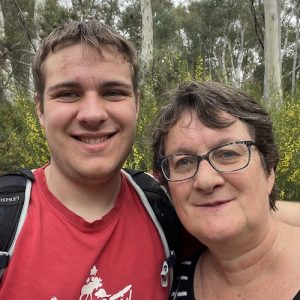
Portrait of Ryan and Corinna GilliganCorinna is a teacher who has lived and worked on four continents. She is now enjoying living in Canberra, where she hopes to put down her roots.

Corinna is also the mother of three amazing young men who have taught her much about life and challenge her to be the best she can be every day. She and her youngest son Ryan have set up a multi-faceted recycling micro-enterprise centred around his many talents.