
Working this out together

Jack Kruger presented alongside his Job Supporter and his work supervisors, providing an overview of his various work roles since he was 14.

Supporting the workplace to support the employee

In this presentation, Jack Kruger will share his various work roles since he was 14. He will describe his current position at Unilodge, where he works at the reception of a residential college at ANU. He’ll also describe his volunteering role at Lifeline.

Julia Shumaker, Jack’s Job Support, will describe how she applied Customised Employment principles to create a volunteering role for him at Lifeline. She’ll explain how her support role at Lifeline has now completely faded. Her experience with Lifeline gave her the confidence to apply the same principles to develop and support Jack in his current paid work role at Unilodge.

James and Rachael, Jack’s work supervisors, will provide an overview of their involvement in customising and supporting Jack in the Unilodge workplace.

Meet Jack Kruger
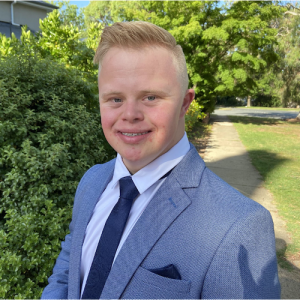
Portrait of Jack KrugerJack Kruger is a CrossFit member, world traveller, movie enthusiast, employee, Learner driver and friend.

Jack attended local schools for his education, and as a result, he is widely known within his community.  Jack graduated from Daramalan College in Canberra, Australia, in 2020.

Since finishing school, Jack has worked in various roles and is paid an award wage. He is now crafting a meaningful week of work, study, sport and leisure.

Meet Julia Shumaker

Portrait of Julia Shumaker

Julia has been Jack Kruger’s Job Developer since 2018. During Jack’s school years and beyond, Julia has helped him secure various employment roles that align with his interests.

Julia has developed many of her skills by attending Social Role Valorisation (SRV) courses and other workshops by Imagine More. In 2022, she participated in a Peer Group that Milton Tyree (from Marc Gold & Associates) co-facilitated to support Job Supporters with their implementation of Customised Employment. She has been applying the knowledge she gained in these sessions to help Jack find and retain suitable work roles over the years.

Apart from being a skilled Job Developer, Julia is also an active member of a local dance studio and enjoys spending time outdoors in nature.

Meet James Jeffress and Rachel Cumming

  • General managers – Portfolio, Unilodge

Portrait of James JeffressJames and Rachel are General Managers for UniLodge @ ANU Portfolio, which manages 13 properties both on and off campus. Their team is responsible for property management and customer service. The team is diverse, with members from different ethnicities, backgrounds, and neurodiverse groups.

Recruiting suitable staff has been challenging in the current job market, but James’s and Rachel’s commitment to serving the community remains unwavering. They take pride in learning and growing with their team to provide the best service possible.

Portrait of Rachael Cumming

Transcription

Jack: Hi, my name is Jack. I am 21 in July. This is my family and Circle of Support. A little about me: I am a CrossFit member, Lifeline volunteer, bike rider, driver, friend. I was fully included at school. I was a business owner at 14 with my cousin. Sol.

I have a Circle of Support. We had a Discovery gathering. My Circle made a list of my interests and a list of my conditions for success, and ideas for work roles. I became a soccer referee at 15. I had work experience in year 10. I did an ASBA in years 11 and 12 at the University of Canberra.

I finished school in 2020. Since I have finished school, I have worked at After School Care and at Government House. Now I have a job five days at work in reception at UniLodge for three hours a day, and I am a volunteer at Lifeline every Thursday morning. I am a CIT student studying a Certificate III in Fitness. My mum and dad and Circle of Support have helped me to get all my jobs. My job mentor, Julia, has supported me in my jobs for many years. I would like to introduce Julia to talk about her roles.

Julia: All right, well done, Jack. You did a really good job, and thank you for your introduction. So, as Jack has just said, my name is Julia, and I’m going to talk to you about my role as a job developer and how I’ve worked alongside Jack’s family and Jack’s employers to get the outcomes he’s gotten in his employment.

So, the way I first came about my mentoring role with Jack was having a personal connection with the Kruger family. So I went through high school with Jack’s older sisters, so I had a bit of a rapport with Jack already. And I had just started uni when I started mentoring, and I was studying teaching, so when the mentoring opportunity came to me from Jan and Paul, I thought the role would align really well.

So, through the years, I’ve worn a few different hats as Jack’s life has evolved through the years, and the most prominent has been the job development role, which will be the focus for today.

What is a job developer? The goal of job development is to identify a workplace that matches Jack’s interests and where his contributions will benefit the workplace. It is not just finding any job and hoping that Jack likes it, as Milton described, “place and pray”. The first and most important step is to get to know the person through the Discovery process, which you have also heard Milton and others talk about over the last couple of days.

So, as Jack mentioned in his presentation, he is volunteering one morning a week at Lifeline. He works with a team of five guys, and this is one of the first opportunities to implement Customised Employment from the beginning. This role is currently fully faded from my support, other than the occasional check-in with members of the team.

And I’d say that personally, I found doing job development for volunteering really, really helpful. It was a time I could practise, uh, without, you know, the pressure or time restraints of a workplace and really take my time to gather observations and make sure I was covering all the steps I needed to do.

And this is really the key to success, taking your time in the setup. And this is definitely proven through this volunteering role. And that and getting the right match. So, there were a lot of reasons why Lifeline was a good match or is a good match, and here are a few. So as you can see, Lifeline ticked a lot of Jack’s Discovery portfolio. So, for example, I’ve just, on the left side is the Discovery note, and then, on the right side, I’ve put where it’s kind of translated in the Lifeline role. I’ll point out a couple. So, for example, in the interests, ‘helping people carry and lift things’, Jack is very motivated intrinsically to help people carry their things if it’s out at home or outside the home, that’s just something that we noticed he does not need to be asked to do that most of the time. He’s quite motivated to help where he can, he’s got a big motivation for that. So, that translated very well into Lifeline because a lot of the job is lifting heavy bags, deconstructing the packing boxes, and doing the setup, and taking donations from people, helping them carry their bags. So there is one example, and I hope I’ve given enough time for you to look through the other ones.

How the Lifeline role came about. You’ll see a recurring theme being that all of Jack’s roles were discovered through Jack’s family’s personal connections, not through a job advertisement. So in this case, Jack’s mum, Jan, had a friend, Linda, who volunteers at Lifeline. So when it came up in conversation, Jan was really curious as to what kind of roles Lifeline offered. They seemed to run many events, and that is why Jan arranged a catch-up for coffee thinking this was an interest of Jack’s. They talked about all the ins and outs of what’s involved in a typical day and shared Jack’s interests as prompts to find out if there would be any tasks that aligned.

Jan also shared Jack’s visual resume with Linda to spark more conversation and to give Linda an understanding about Jack. And then Linda offered to introduce us to the Lifeline Coordinators, and we ended up being connected with Lisa, who was the warehouse manager at Lifeline. And this was actually a bit unexpected, and we didn’t know much about what happened at the warehouse, but we thought it was worth looking into.

So Jan and Lisa connected via email after this conversation, and then through a few exchanges, they arranged a tour for Jan, myself, Jack to go and have a look. As we were new to what happened at the Lifeline warehouse, we were surprised to see a very well-oiled machine. They receive daily donations of books, CDs, DVDs, and those all get repacked, then accepted, or if they’re not accepted, sorted, repacked again, to store for the big Lifeline book fairs that are held twice a year here in Canberra. So there was a lot to see in a very short amount of time, you’re not always going to see everything, but that is where the next part comes in.

So, before the tour commenced, we introduced Customised Employment and described how this would benefit the workplace as well as ensure Jack was contributing through his interests, and Lisa seemed really open to the idea, which was awesome. And we gained insight to the different roles, expectations, and tasks being performed. We also asked a lot of questions and discovered tasks that should get done but don’t get done, also known as ‘unmet needs’, in case some of these match Jack’s interests.

Throughout the tour, we pointed out how Customised Employment would work to reinforce that it is about getting the match of Jack’s interests and conditions for success right so then Jack could best contribute to the workplace. We were able to see how all the tasks worked, including the ones that were pitched by Lisa, and also the ones that had not been mentioned. In Lifeline, there are quite a few stations, as you can imagine, from all those tasks, so there was definitely a lot to see. From that time we were able to identify tasks that would be really interesting and suitable for Jack, as well as some that wouldn’t be as good of a fit. And this is really the importance of Customised Employment and not saying yes to everything on offer, which can feel uncomfortable, but it’s really important to keep in mind and make clear that sticking to the best-fitting tasks are going to be of benefit to both the employee and the workplace.

So on this tour, we were vocal about things we knew wouldn’t be a good match. For example, the warehouse team did a lot of their tasks together. Immediately that is a very big tick: That’s a key condition for Jack. And also a lot of the tasks had a clear end result so that Jack knew the job was completed; there was a clear end step. In the top picture, two of the team members are repacking donations into some more sturdy boxes after they’ve, you know, been donated. And the end result is that the box is full. And what we did note, though, that repacking different-sized books did require a bit of Tetris really, because they’re all different sizes, and that requires making quite a few judgment calls, which we did think would be a bit difficult for Jack to start with. However, we did find something along the same lines, and it’s around the DVDs and the CDs, so they do the same thing; they repack the CDs and DVDs, but they’re all of similar size.

So just that small change really makes a difference because that would be very ideal because Jack could easily be shown how to stack them on its side and we know they’re all going to fit. And he would also be able to do this job alongside the team who might also be stacking, you know, the books, but it doesn’t look out of place because every… both these jobs need to get done. So we’ve figured, if that job is got to suit Jack the best, then that is the job where he starts. And yeah, so we kept this in mind.

An example of a task we had to decline was actually in reference to the bottom picture. So, the task was wiping down the plastic children’s books. The team member that had been on that task, they had left, so naturally Lisa thought that’s probably a good place to slot in. But we did have other ideas about that, and that was because, first of all, cleaning is a lot of judgment, and we knew that that was difficult for Jack. So we thought, again, that’s not a good place to start, it’s not very motivating, and it was performed alone, which goes against Jack’s key conditions for success. And also it could potentially feed into the negative juxtaposition people with disabilities face when it comes to being seen as childlike.

So while not task-related, it was important to be thinking about Jack’s image and how he’ll be seen by others as this would impact about how he would be treated, and that is what we call SRV.

So, after the tour, Jan and I talked about what we had noticed and decided it was definitely worth exploring further. I then arranged several visits over approximately three weeks. I went and observed the tasks we’d all thought were fitting from our tour and learned about some other tasks that were not so obvious.

I went on different days to meet everybody and quickly identified that the Thursday warehouse team was going to be a really good fit for Jack. It was a group of guys who’d been volunteering together for years, so there was already an established rapport, and they knew the tasks really well. I got them to show me all the tasks in depth, so I had a deep understanding of the steps being taught and gained an insight on the staff’s natural teaching approach.

Understanding the steps of the tasks also helped if we needed to make any modifications later if he was having any difficulty. In this process, I was able to discover who I thought would have a good, would have good teaching skills suitable to Jack’s learning needs, and who he would click well with.

And I also learned about the social culture of the workplace, things like, do they have morning tea together, and how does that happen? So they did, they have morning tea at a set time and everyone takes turns shouting coffee. And these are just as important as the job itself, as it is an opportunity to connect with the team and build relationship, very important things in a workplace.

So, throughout this time, I was capturing videos and images to show Jack’s family my discoveries, so we could all properly reflect on the observations. We identified that Jack would thrive in greeting the people who drove in to offer their book donations as they were short interactions that Jack loved. He could use his strength by assisting in carrying the donations to the table for sorting. Jack would then either sort DVDs or break down boxes with the team.

After everything was finalised, we put together our findings into a customised job description to present to Lisa. Lisa thought that the job tasks would be of great benefit to the workplace and could see how they would suit Jack, so she notified the warehouse team that Jack would be joining and setting up when to learn the tasks.

12 months later: So, Jack is performing the tasks identified with a lot of enthusiasm. It’s something he looks forward to every week, so, you know, that is very successful. He’s got morning tea with the team and is contributing to buying the coffee. So we make sure that when it’s his turn, four weeks down the track, he has cash to bring along. He’s got phone numbers of team members, and we support to contact the team if he might be away and independently travels to and from, so we’ve set up a bit of a system where Jack has some timers set to automatically come on. I mean, we’re adjusting that, uh, to notify him to order an Uber so that to Lifeline and back home. And I check in every once in a while as well, using targeted questions to see how everything is going.

This is Jack’s paid employment; Uni Lodge, and he is in parcel management and he, as Jack said, he’s working every day, uh, five days a week with varying hours. So his role there is logging the parcels that arrive from outside of the university for the students who live on campus, and so they need to be processed internally as well. So that is the team that Jack is a part of. And he’s also in charge of giving the parcels to the students who come down to collect as well. That’s part of that role, too.

So how did the role come about? So the job was first discovered through, again, a friend of Jan’s working at an ANU residential lodge. So Jan and I did a tour and identified tasks that would align with Jack’s interests. But unfortunately, at the time, COVID was doing its thing. And it did quite, it stalled quite a lot of the job development, and eventually there was a really big restructure of staff. And the job did unfortunately fall through due to those circumstances.

However, we didn’t want to give up on that. We thought there were, there was definitely something worth exploring there, and Jan was talking to other families, and that’s a very key part of all this; keep talking to your network, you never know who knows who. And a new connection was made with Uni Lodge. She emailed both Rachel and James at Uni Lodge asking to meet, to explore a work opportunity for Jack and what had happened with the restructure and mentioning some names of people they would know. Jan met with James to describe Customised Employment and share a little about Jack through his visual resume.

And this is an example of that. There’s lots of different ways you could do a visual resume: Here is a snippet of Jack’s. And this is also something that Jan took along for that first meeting with James. So much like with Lifeline, it was important to get everyone across Customised Employment from the very beginning and highlight how much benefit it would be to the workplace. So, as you can see, this is something that Jan and her family created, and I think it’s such a good resource. It just really clearly outlines everything about Customised Employment, what my role is, how the workplace is supported, just everything, it’s really good.

The observations. So I visited several times, different times of the day and different days just to see as much as I can. And I started with one lodge, as they have quite a lot of lodges and parcel management fell into the realm of tasks better performed by others because there was such a huge influx of parcels, and the team at reception were struggling to keep up with that, as well as the other things that they needed to do. So we looked at that as an opportunity of where there could potentially be a role.

And we did identify that there was a difference from the first time that we did the tour. We had to make note of that, but we thought this was actually a really good system that they were doing currently. Yeah. So what did I do? I watched all the parcel processing and did find that was a very good fit. I also identified that it’s good because there’s movement in it. There’s contact with other people, like the students. Working alongside a team member, that was also going to be really motivating. So through the observations, I was also keeping an eye out on some people who might click really well with Jack and some natural teachers.

And yeah, looking, we tried to also identify the unmet needs of the workplace and something we all talked about really early on was parcel deliveries, because currently the students would come down to collect their parcels, because they would be notified via email. But something we did mention was, would it be possible that they get taken up to the students? And that is something that Rachel and James said, “Yeah, I’m sure everyone would like that”. So that is something that we identified quite early on, but we actually have, we’re currently just in the very starting process of getting that together, but since it is a brand new job, it’s not in existence yet, it needs to take some time to develop in a way that’s going to work well for everybody.

What is involved in doing job development? Understanding the tasks and the steps of each task, and so through that, I do a task analysis for my purposes so that if Jack is having difficulty, it’ll be easy to identify where we might need to add a step or elaborate on a step or break down a step even more.

Understanding the culture of the workplace, so how long have staff been there, as Milton mentioned. So, at Lena Karmel, one of the lodges, Nova had been there a while, as had Josh at Davey Lodge, so we took them on board as well. So it looked like it was going to be an environment with, consistent staff, but COVID, and life, it does have an impact. So yeah. And that is all right. That is just something that you work through.

And also, it’s really important for me to support the staff to teach Jack and as Milton mentioned, not taking over with the teaching. And that can happen because staff members I acknowledge don’t always feel very confident in giving the instructions in a clear and direct way. But so often I’ve said, “Actually, that is perfect how you’re doing it. It’s not being bossy or anything if you break it down clearly and precisely and keep it simple, that is really effective,” and I really try and tell people, “You’re doing a good job and keep doing it,” because I know how it can feel on the other side of things, so I do try my best to support them in that way as well.

Here are some more points. With job development, it’s important that all the tasks are clearly identified and negotiated, providing training and induction in the typical way. So finding out when it’s completed, where it’s completed, and in what form it takes. For example, UniLodge has online training, making sure that all the staff are providing their training and not, and that I am removed as possible.

There are some moments where, if there needs to be something said to how they’ve taught Jack the task, I’ll tell them afterwards, like, I don’t jump in and you know, take over. It’s really important not to do that as a way to have those kinds of conversations, and in the way that you do it. The impact of my presence and the job developer presence, and this is such a tricky bit, but it makes such a huge difference, like just me being at the workplace sends a very loud message, and that is why we have tried to highlight from the beginning that the overall goal with my role is that I’m going to fade and that Jack can be fully supported by his team and his supervisors.

And Jack is really keen to do the job without support, as I assume many people are. They want to feel competent and capable, and so it’s really important to honour that. So the way that I do this, practically, I’m still really learning about it is, checking in using targeted questions, really finding out if there’s anything within the method that we need to do some more work around, or how is he going with typing in this particular area. Those are just a couple of things that I try to identify, not just saying, “How is he going?” because that’s very, very broad. So, really trying to acknowledge where there may have been challenges and going, how is he going with this particular thing? What are you noticing, so, that you can work on individual things.

So finding other work to do. So I really do try to step back where I can, and since Jack is doing really well with picking up this parcel logging process, that’s my opportunity to take a step back, and I will remove myself from the environment to send a different message and say, ‘Jack’s got this, and you’ve got this’, like, I don’t need to be here right now. So that’s a really intentional thing that I try to do. So in that time, I might scout around for more tasks, check in with the other lodges as he rotates around. A few observe just from afar, like not just hanging over his shoulder because I understand, you know, there are students who come in to reception and if I’m just standing there hovering, that also sends a message to a different group of people as well.

Something I also do is develop some scripts for Jack to engage with students. There are lots of questions that the students can ask, so we’re trying to work around that and trying to build some confidence around, you know, the unknown, because there is a lot of things that they could potentially ask. But that is something still in progress. And I will say, you know, it is always a work in progress. And at the moment, eight months down the track, I’m checking in three days out of the five. So that Jack, we are starting that, fading with those two days where I don’t come in:

10 months on, what has changed? So Jack is working across four lodges, doing some split shifts. It’s really great to see him known and valued in the community by both his team, but as you can see in the top right photo, by residents, or you know, just people who come in, he feels confident to have those conversations with people and I have noticed people come in and they know him by name and I know that means so much for Jack. He really enjoys having those conversations, and he’s really seen when, you know, someone says, “Hey Jack, how you going?” It’s really good. It’s good to see.

We’re still working closely with Uni Lodge staff to get consistent methods, so, you know, things do change and you make adjustments and, yeah, we’re working on making sure everyone knows all those adjustments and yeah, but as I said, there’s lots of people, so, you know, these things take time, they really do, but it’s so great that we’ve got very supportive supervisors for Jack who really work hard to make all this happen for him as well.

He independently travels to and from work and home, so often Jack rides his bike. He, that was something that he practised a lot, getting the root down, and now he does that independently. And something we’ve introduced recently is catching the bus as well, so practising what that looks like. We are using, we’re trying a different couple of apps to notify him when to catch the bus, and there are a couple of good ones. So those have been helpful in assisting with that process as well.

And we do always want to keep an eye out for new opportunities for Jack’s role, expand where we can, so going back to that unmet need at the very beginning of the process with the parcel deliveries, as I mentioned, that is something that we are working on currently. And James took it upon himself to take Jack along with him the other day, just to give it a go and see how it could look. And I found that really helpful because you could, it can kind of prompt things that you might not think of just sitting down and thinking about it, you could see what things might need to be in place and what steps need to be really clear. So that was really good, and I’m excited for that to come into effect.

So thank you so much, and I’m actually going to hand over to Rachel and James, and they’re going to share about their experience as well. So give them a welcome.

James: Thank you, Julia, and thanks for having us today. There’ll be a bit of repetition: Julia’s gone over in great deal detail and thank you, Julia. But I guess this is really from our perspective and how we’ve seen the process go. So yeah, thank you very much. We’re really grateful to Jan and Julia and most importantly, Jack, for taking us on this Customised Employment journey.

We’re delighted to have Jack as part of our team. For context, we are an Australian student accommodation management company, and we have a portfolio across Australia and New Zealand with 40,000 beds under our management. And, we also manage short stay hospital accommodation as Essence and build rent properties as Essence Communities.

Rachel and I manage the ANU portfolio of properties: It’s about five and a half thousand beds across 13 properties that we manage, both on and off the ANU campus, in a mix of full management with operational wellbeing support, and hybrid management where we manage the operations and ANU managers, our Student Wellbeing.

We’ve got another 3000 beds under UniLodge Management at the University of Canberra. So, we are a big, growing organisation, and we certainly have our hands over the entire sector in the ACT, and we’ve done a really good job of building our relationships with the two major universities in particular. To address kind of that big box theory, I suppose we’re a management company, we’re a service deliverer. And every single one of those management agreements across the entire Uni Lodge portfolio, across Australia and New Zealand, is very independently generated. So it’s meeting the needs of that university or that place. And so, we don’t really see ourselves in that light: We see ourselves as very much a local operator doing local work and working very much within the ACT and the ANU community as well.

So Jack works across the precinct of properties known as the Exchange Precinct, which includes Davey Lodge, Kinloch Lodge, Warrumbul Lodge, and Lena Karmel Lodge. So you might have seen, the corner of Marcus Clark and Barry Drive in the city, for those Canberrans amongst you, keep an eye out for Jack.

We came to know of Jack’s work interest through a slightly less direct route than what has been described this morning. Jack’s mum had met with the then Director of Residential Experience at the ANU and considered possible task fit for Jack within one of the other halls that was managed by the ANU.

Unfortunately, as you know, this opportunity fell through, but Jack’s mum was referred to me as a possible location for Jack to join our team. As fate would have it, we now operate that building that was previously in line to take Jack on in a similar type of role. So, we were destined to work with Jack.

Rachel, and I love to build efficiency into everything that we do with the intended purpose of creating more meaningful interactions between staff and students. We’re constantly thriving to lift our eyes away from a computer and look at people and talk to people, which is very important to us. But with the burgeoning online shopping market post-COVID, our staff were drowning in accepting, logging and distributing mail.

I’m grateful to have had the chat with Jack and his mum. We were certainly in a parcel delivery, tracking and distribution deficit, and it made a great deal of sense to apply resources to that workload and engage Jack. We have had success in the past with another example of… I use “Customised Employment” because that’s where we are today, but we worked with David Smith from Employ for Ability in successfully transitioning an employee with autism and, with ongoing support from David, we have placed them, or learned about them and placed them into a role in which they were thriving. So this kind of resonated with us and I guess with that in mind, we were really willing to take on this opportunity. I’ll hand over to Rachel.

Rachael: With Jack’s Customised Employment, we really appreciated the side-by-side approach with the support of Jack’s mum and Julia. We gave every opportunity required to Julia to observe our workplace and the tasks that our team do on a day-to-day basis. And that actually seamlessly blended in when Jack transitioned into the workplace with us.

And she has now graduated to being three days a week, which we really appreciate because it means that Jack has got the confidence to do those roles and knows the team, people in the team that he can go to for assistance if he does need that there.

Julia did a great job in building the confidence among our staff who work alongside Jack. The staff have tended to be a little bit more reserved in terms of directing Jack and giving him feedback on the tasks. And so Julia has been able to give our staff tips and tricks on how to do that and really boost their confidence in engaging with Jack in a way that allows him to complete the tasks confidently.

One of the conditions that was put forward pretty early from us was the requirement that Jack would need to be able to work across multiple locations. So, as Julia mentioned, we’ve got the four lodges, which are in quite close proximity to each other, so it made the most sense for us to start Jack in that location.

It would mean that the workload could also fluctuate, some buildings naturally get more parcels than others, so Jack needed to be able to go where the work was, depending on the day of the week, and that’s allowed us to take advantage of this Customised Employment, knowing that there are three other locations that Jack could go to if the first building that he goes to doesn’t have many parcels that day.

We understood Jack values connection, building relationships, and consistencies, and we’ve been really proud of how Jack adapts to those movements across the portfolio and the consistency in his attitude to wherever he gets rostered that week. We chose specific buildings for Jack to start his shifts in based on the building manager’s rapport with Jack and the confidence to manage his workload and call around the rest of the portfolio to see where there were services needed by Jack that day.

Any challenges we’ve faced, we’ve been able to overcome by working with Jack with the support of Julia and Jan, be it the changes in scenery, staff time management, or setting reasonable targets. We’ve dealt with the motivation, we’ve dealt with motivation, distractions, interpersonal matters, and we’ve really appreciated the approach of Jack, Julia, and Jan in working with us to remedy these situations.

We’re now exploring expanding the role, as James and Julia have said, and we hope to include, on top of delivery, parcel delivery to rooms, handling student IDs for when they borrow something from reception, signing for the mail when we receive it, recoding keys for room access, and potentially taking phone calls as well.

We’re fortunate to have a good set of policies and procedures to guide these future work possibilities with Jack, and some pragmatic thinking to get it across the line to specialise the tasks for Jack

James: Jack’s great to have around our office and we thoroughly enjoy our interactions with him. He always has something to talk to us about: Favourite music, NBA scores, and the big 21st birthday coming up, but he can keep his impending holiday to Italy to himself, we’re sick of hearing about that. The team have bonded well with him and we’re trying to expose him more and more to the residents, but we know how much they appreciate him sorting the parcels out. There’s nothing more important to them.

We haven’t found this process to be intimidating. I can say that at times we wish we could focus all of our attention on designing these roles and preparing and training staff to facilitate the best environment for Jack. But, given the size of our portfolio and the evolving nature of it, we’ve relied heavily on Julia to support Jack’s success within UniLodge. We benefited somewhat from a challenging period for human resources in an employee’s market, which gave us the ability to allocate greater resources to our casual workforce and we’re just grateful that Jack chose us.

We encourage all employees not to be apprehensive about creating Customised Employment opportunities within their team. We’ve seen Jack’s peers and managers benefit from the experience of managing a diverse workforce, and their skills in management and stakeholder engagement have grown considerably.

Knowing what I know now, with Jack’s family, in hindsight, as an employer, I would happily invite the Julias of the world to our workplace and give them the time they need to identify jobs suitable for Customised Employment, in the remarkably stealthy way she knows how. Thank you for being part of our team, Jack. Thank you.